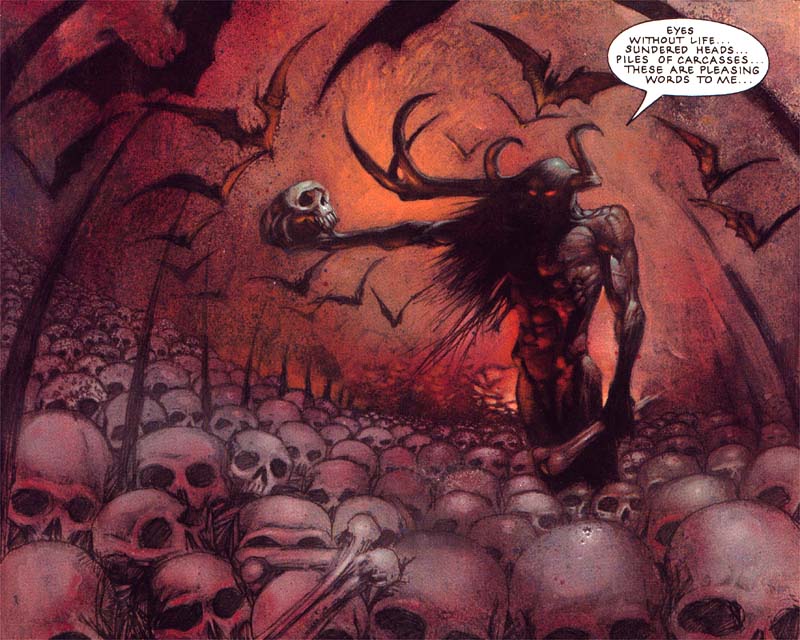
A hell-scape rendered entirely in blood-red and black, built from a field of bleached skulls stretching to the horizon under a sky thick with wheeling bats. At its center strides a gaunt, antlered demon, its wiry body rendered almost as exposed muscle and sinew, dark hair or smoke streaming back from its head, one hand raised to hold a single skull almost tenderly, as if displaying a prize. A speech balloon carries the piece's dark punchline in the creature's own voice: eyes without life, sundered heads, piles of carcasses - these are pleasing words to me. The line turns an already grim image into something closer to a character statement, a monster savoring the language of atrocity the way another figure might savor poetry, and the flat, near-monochrome palette of red on red gives the whole scene a suffocating, infernal heat. Bisley's list of influences includes artists drawn to distorted, exaggerated anatomy - Egon Schiele's gaunt, angular figures and Gustav Klimt's ornamental intensity among them - and this creature's elongated limbs and stylised antlers owe something to that same appetite for the body pushed past naturalism into pure expressive shape. It's an image built to unsettle through accumulation as much as through any single grotesque detail - skull after skull after skull - with the demon's calm, almost thoughtful pose making the horror feel considered rather than frenzied, a connoisseur surveying his own handiwork.
 Words that a pleasing