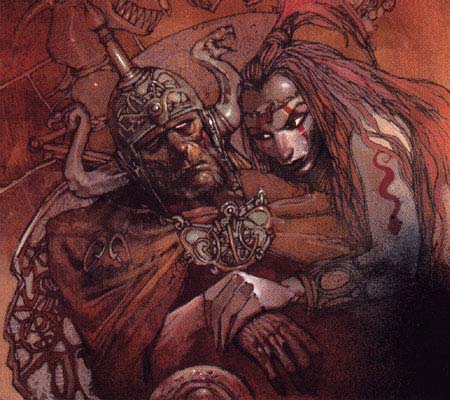
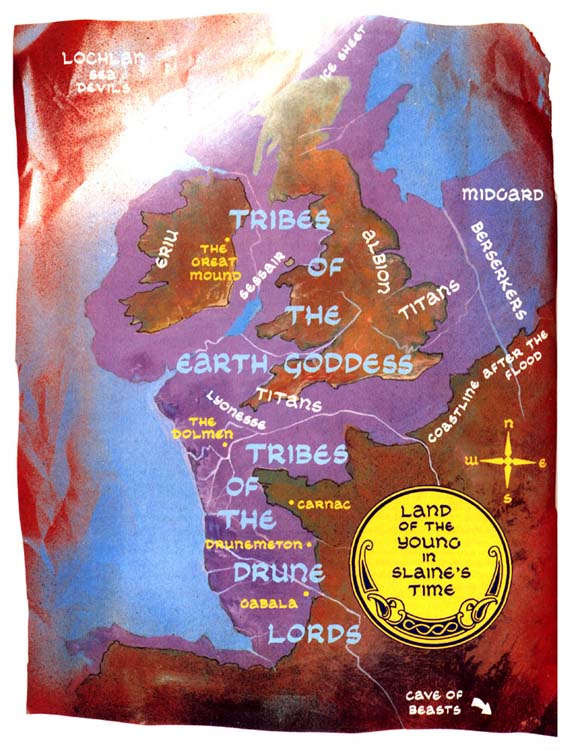
A close, quiet character study built almost entirely from two faces pressed together in the dim orange glow of what might be firelight or a battlefield fire. A grizzled, heavily bearded king dominates the left of the frame, weighed down by an ornate horned or winged helmet and thick fur-trimmed collar, his eyes lowered in exhaustion or grief. Beside him, a younger woman with red-streaked white hair and pale ceremonial face-paint leans in close, her expression watchful, almost protective, one hand resting near his. Behind them, barely visible in the murk, a grinning skull motif is carved or painted into the background architecture, a reminder that this quiet moment is happening somewhere much darker than it first appears. The whole piece is rendered in warm, smoky ochres and deep reds, the kind of restrained, painterly palette Bisley used when a scene called for weight and stillness rather than the kinetic violence of his monster and combat pieces. There's a strong current of Celtic and pseudo-historical iconography running through the imagery - the horned helm, the ceremonial paint, the funerary skull carving - that echoes the tribal, druidic world-building of Sláine, the strip that did more than any other to define Bisley's painted style once he took it over in the late 1980s. Whether or not this particular king belongs to that continuity, the visual language is unmistakably drawn from the same well: age, grief and old power rendered with real tenderness rather than spectacle.
 Very old king by Simon Bisley