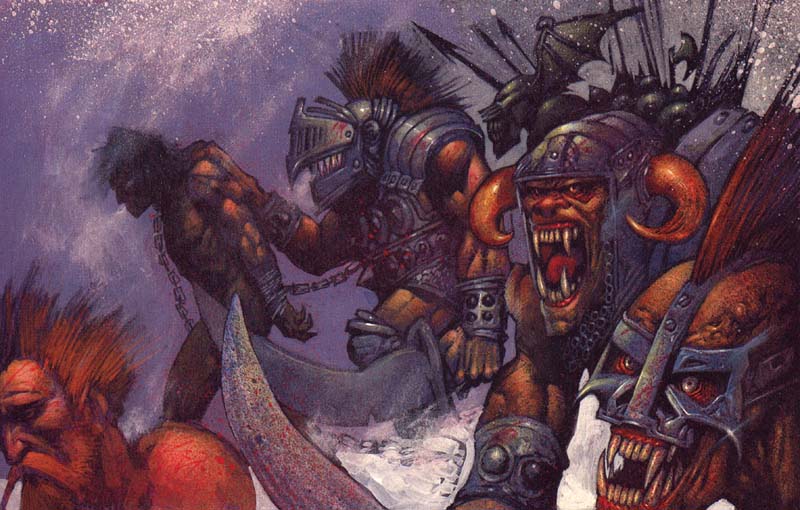
Slaine strides forward in chains, his own axe raised threateningly over his shoulder even as restraints bind his wrist, flanked by a grinning, horn-helmeted warrior clad in ornate spiked armour. Behind them press two more fighters, a fanged orange-horned brute baring its teeth and a scarred, red-eyed warrior wearing a jagged metal mask, their combined presence turning the panel into an intimidating wall of approaching menace. The purple-toned background, streaked with white motion lines suggesting wind, rain or magical energy, gives the scene a stormy, otherworldly charge, while the muted colour restraint on the figures makes the small flashes of orange and red in their armour and eyes pop with real intensity. Despite the title's suggestion that the fight is coming to Slaine rather than the other way around, his stance and raised weapon show him already prepared to meet it head-on, chains notwithstanding, a recurring image of the character as captive but never cowed. The layered staging of four figures, each rendered with a distinct silhouette and expression, is a good example of Bisley's skill at group composition, keeping every character legible even as they crowd toward the viewer in a single dense mass. Pat Mills built Slaine's world on Celtic and pseudo-historical tribal warfare, and scenes like this, warriors bound in chains, closing in for violence beneath a churning sky, are exactly the kind of visceral confrontation that made Bisley's painted take on the strip so influential after he took it over in the late 1980s.
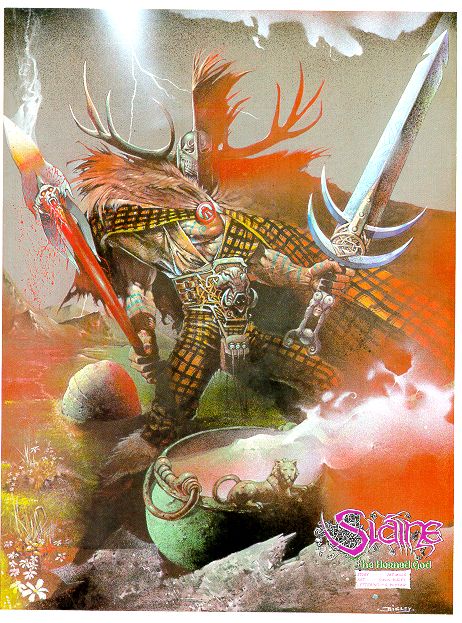
 The fight somes to Slaine