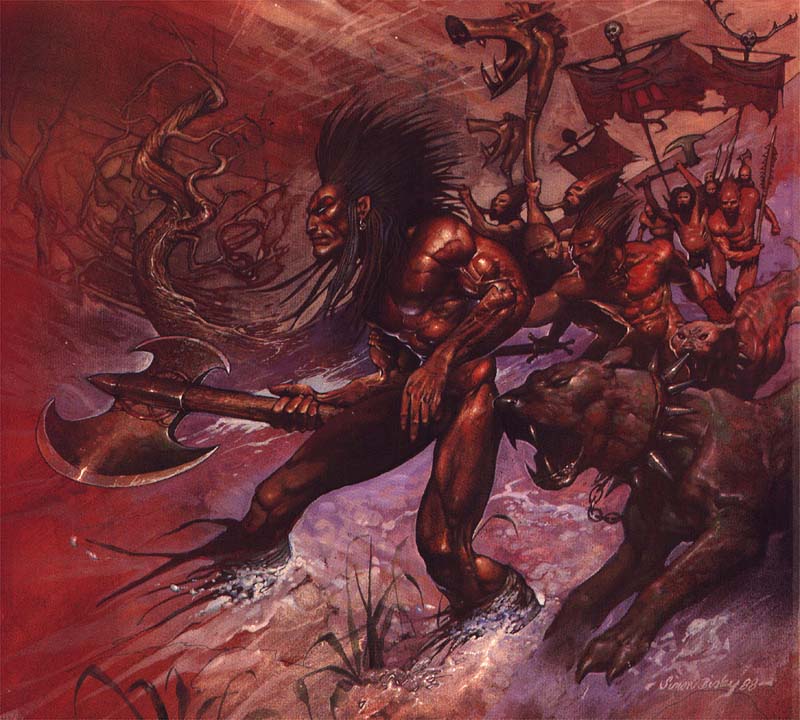
A sprawling double-page battle spread, one of the most densely populated images in the archive. In the upper left, Sláine stands alone on a rise, axe shouldered, watching the chaos below; at upper right, a second, more distant view shows him locked in personal combat, hoisting an enemy overhead by the throat. Between them the entire lower two-thirds of the page dissolves into a heaving mass of tribal warriors, spears, shields marked with spiral Celtic knotwork, and grotesque Fomorian creatures with bat-like wings and tusked jaws, all rendered in a blood-soaked red-brown palette. Captions narrate the assembling of the tribes of the Earth Goddess Danu, commanded by their five mighty kings, king Gann of Murias, his brother king Cesnann of Finias, the boy-king Aurdaigh of Gorias and mad king Sengann of Falias, gathered under Sláine as ard rí, the king of kings, to do battle with the Fomorians who had laid waste to Tír na nÓg. This is Sláines mythology at its most fully unpacked: the pseudo-historical Celtic tribal structure and the Earth Goddess cult that writer Pat Mills built the strip around, with the Fomorians standing in for the story's ancient, monstrous enemy. Bisleys crowd-scene technique, dozens of individually rendered combatants without the page ever losing legibility, remains one of the most technically demanding aspects of his work on the series. Spreads on this scale were rare even within his own output, requiring him to balance the same painterly looseness that defined his close-up figure work with enough structural clarity that a reader could still track Sláine across two separated vantage points, and it stands as one of the clearest demonstrations in the archive of just how far his ambitions for the strip had grown beyond single-figure pin-up art.
 Slaine overlooking his war