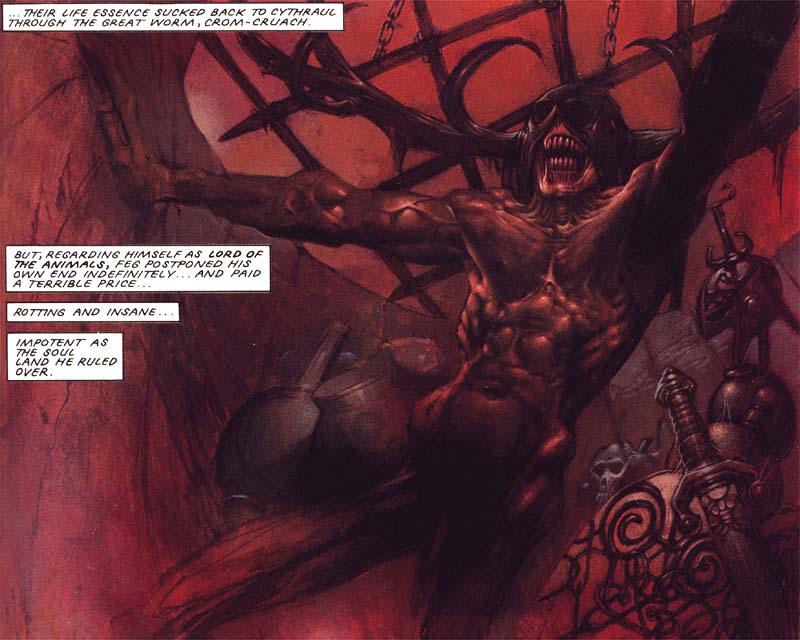
A dark, blood-red panel depicting a horned, skull-faced figure bound or crucified against a thorny wooden frame hung with chains, arms outstretched, ribs and sinew visible through torn, rotting flesh. Captions describe their life essence sucked back to Cythraul through the great worm Crom-Cruach, and note that the figure, regarding himself as lord of the animals, postponed his own end indefinitely and paid a terrible price, now rotting and insane, impotent as the land he ruled over. This is not Sláine himself but one of the strips villainous rival lords, undone by clinging to power past its natural end and left as a grotesque, immortal ruin nailed up in punishment. Crom-Cruach is drawn from genuine Irish mythology, a serpent idol associated with human sacrifice, which writer Pat Mills folded into the strips already dense web of pseudo-Celtic lore alongside the Fomorians and the Earth Goddess Danu. Bisleys rendering leans fully into body horror here, decayed musculature, exposed bone, a mouth full of jagged teeth, painted with the same thick, tactile brushwork he brings to heroic figures, proof that his technique translated just as effectively to images of rot and ruin as to triumphant muscle. Scenes like this also demonstrate how thoroughly the strips mythology functions as a moral universe as well as a fantastical one, where hoarding power against the natural order, refusing the cycle of death and rebirth that the Earth Goddess and her cauldron represent, is treated as the deepest transgression a ruler can commit, punished here with a fate considerably worse than simple death.
 Slaine is tortured