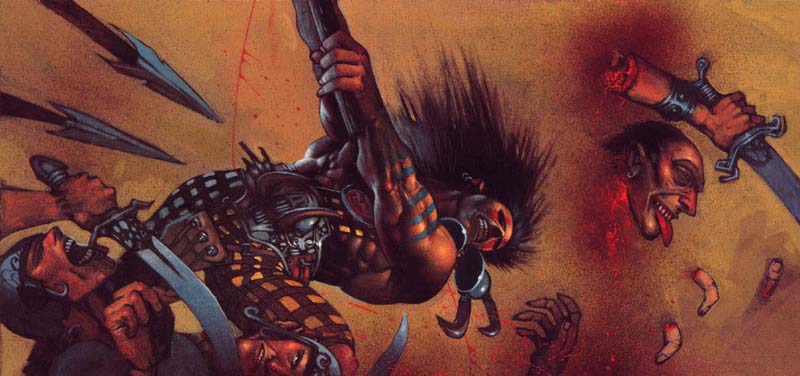
A widescreen painted panel that catches Sláine mid-leap through the air, body twisted and airborne above a thicket of raised spears, his tattooed arm cocked back with a weapon while blood sprays in a fine red mist across the tan background. Below and around him the debris of combat is scattered with unsettling specificity: a severed head, a disembodied hand, jagged spearpoints bristling upward from a mass of shadowy, cackling attackers pressed into the lower corners of the frame. The color work is warm and desaturated, dusty ochres and browns punctuated only by the vivid red of the blood spatter, which reads almost like a spotlight on the violence itself. Bisleys command of the airborne pose, hair and cloak trailing to sell the momentum, weapon still following through from a strike already landed, turns a single frozen instant into something that feels like it is still moving. Its an image built entirely around velocity and consequence rather than a coherent tactical moment, more interested in what a Sláine battle feels like than what it looks like from any sensible camera angle, which is very much the visual language the strip settled into once Bisley took the art chores. That shift away from clean, legible staging toward pure sensation, weapons and bodies mid-arc, blood caught as texture rather than plot detail, is one of the clearest fingerprints of his run, and it is a large part of why his Sláine pages still read as viscerally exciting even stripped of any surrounding dialogue or narration.
 Slaine fights